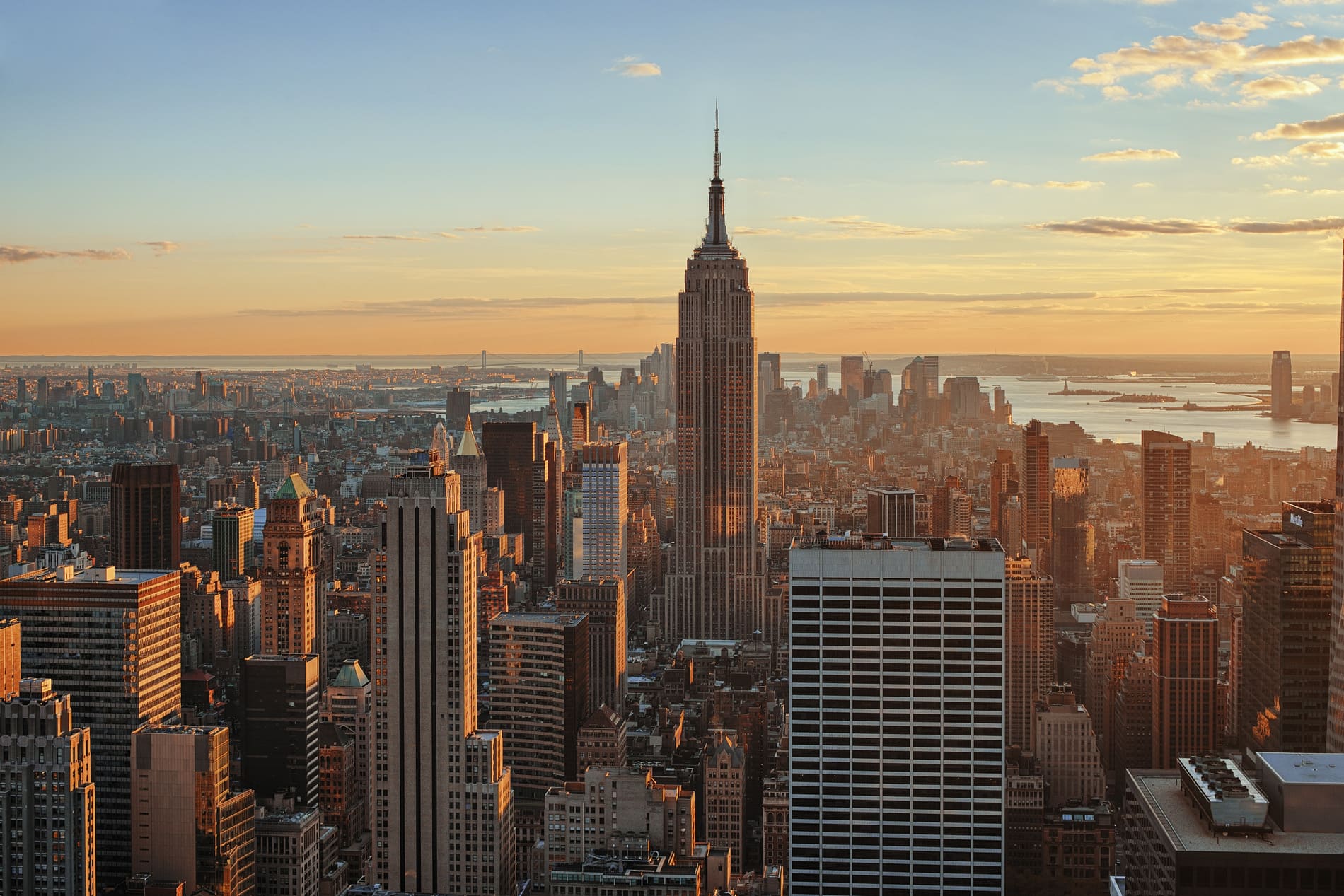
1. Chrysler Building
The Chrysler Building, New York City’s third tallest structure, is a 77-story skyscraper that is regarded as one of the city’s most admired icons. This Art Deco structure is located in the Turtle Bay neighborhood of Manhattan, near the intersection of 42nd Street and Lexington Avenue. The Chrysler Building, formerly the world’s tallest tower, was also one of the most adorned offices in the world. The structure is made of stainless chromium-nickel steel, with tiny triangular windows and a 185-foot stainless spire on top. The American Institute of Architects has named this massive and majestic monument eighth on their list of America’s Favorite Architecture.
It was the world’s highest building for 11 months until the Empire State Building overtook it in 1931. The Chrysler Building remains the world’s highest masonry structure. The Chrysler Building’s terraced crown is well-known and well-known. The crown, which is made up of seven radiating terraced arches, is a cruciform groyne vault made up of seven concentric elements with transitional setbacks that are stacked one on top of the other. Hubcaps, fenders, and radiator caps are just a few of the building’s subtle references to Chrysler’s automobile empire. The iconic eagle gargoyles even look like a real Chrysler hood decoration.
Huge stylized eagle heads, pineapples, and automobile-related designs adorn the Chrysler Building. The foyer, with its marble, chrome, and fresco, is even more of an art deco extravagance. The eagles are on the 61st floor, while the 31st floor has replicas of the 1929 Chrysler radiator caps.
Surprisingly, the building’s façade features 3,862 windows. Did you know that more than 750 miles of electrical conductor wire, the equivalent of the distance between New York City and Chicago, were utilized in the building of this skyscraper? Since 1976, the Chrysler Building has been designated as a National Historic Landmark. On the excuse of involvement in the financial arrangements with the building’s builders, architect William Van Alen was never paid his fees.
2. The Statue of Liberty
The Statue of Liberty was a gift from the French people to the Americans on July 4, 1776, to commemorate the birth of the United States of America. The Statue of Liberty was completed in France in July 1884 and arrived in New York Harbor on the French ship Isere in June 1885. ‘Liberty Enlightening the World’ is the complete name, which is a mouthful. The Statue of Liberty has a far more appealing ring to it.
The statue’s face is said to represent that of Bartholdi’s mother, Charlotte. That’s a tough Mother’s Day present to surpass. The original architect recruited by Bartholdi to design the monument’s internal structure was Eugene Viollet-le-Duc. In 1879, however, he died suddenly. Gustave Eiffel, the architect of the Eiffel Tower, was enlisted to assist in the creation of the statue. Eugene Viollet-le-Duc succeeded him. Both France and the United States contributed $102,000 to help build it. It took 5 years to raise the necessary funds. Over 300 overlapping copper plates make up the gigantic lady. The copper is 31 tonnes in weight. That’s a significant amount of copper!
Due to oxidation, the copper plates that cover the statue have turned green. The head of the statue was positioned slightly off-center, by around two feet. There are 25 windows in the crown. The windows are said to represent the earth’s ‘natural minerals.’ Liberty is an idea that brings people together. The crown’s seven spikes reflect the world’s seven continents and oceans. Broken chains can be seen at the statue’s feet. This signifies the chains of oppression and tyranny that have been broken. You must be physically fit to reach the top, as there are 354 stairs to climb. The foundations were constructed with 125 tonnes of iron.
When it was unveiled in 1886, it was the tallest iron building ever built, standing at 93 meters. The torch has a 24k gold leaf finish. Get your binoculars ready since the flame and tablet are inscribed with the American Declaration of Independence date. An 11-pointed star-shaped granite fort pedestal supports it. The concrete utilized in the pedestal’s construction weighs 27000 tonnes. The gigantic lady isn’t a size zero with a waistline of 35 feet. A size 879 would be required if the Green Goddess went to Foot Locker or JD Sports to purchase new shoes. The attraction was designated as a UNESCO World Heritage Site in 1984.
3. Brooklyn Bridge
The hybrid suspension and cable-stayed bridge connecting lower Manhattan to its neighbor across the East River is known as the “Brooklyn Bridge,” however the moniker changed over time. The project was first referred to as the “Brooklyn Bridge” in 1867 by the Brooklyn Daily Eagle, although it was also known as the “Great East River Bridge” and the “Great East River Suspension Bridge” in its early years. It was given the clumsy official name of “New York and Brooklyn Bridge” when it was dedicated in 1883. (Brooklyn will not join the city of New York until 1898.) In 1915, the name was formally changed to the “Brooklyn Bridge” to reflect the city’s pride.
The Brooklyn Bridge carries more traffic than the original designers anticipated, with over 100,000 cars and 4,000 people passing through each day. P.T. Barnum used 21 elephants to demonstrate the bridge’s stability, thus, this is a significant increase.
Peregrine falcons live in the bridge’s penthouses, which are placed in the two towers. The birds, just a few more stressed commuters who avoid the worst traffic congestion by flying, may regularly be seen coming and going from the bridge.
Paintings by Andy Warhol and Georgia O’Keeffe, pictures by Walker Evans, plays, books, movies, and poems by Jack Kerouac, and artists like Simon and Garfunkel have all been inspired by the Brooklyn Bridge. The Bridge as a Backdrop: Annie Hall, I Am Legend, Once Upon a Time in America, It Happened in Brooklyn, Gangs of New York, Godzilla, The Avengers, and The Dark Knight Rises are just a few of the movies and sitcoms that have used the bridge as a backdrop.
The Brooklyn Bridge is a prominent tourist attraction and one of New York City’s most important sights. The bridge’s opening contributed to Brooklyn’s transformation from a rural area to one of the world’s busiest urban areas.
The views of the New York skyline, the Statue of Liberty, and the East River are stunning, and strolling along the river might be one of the most romantic things to do in New York.
4. Metropolitan Museum of Art
The Metropolitan Museum of Art, usually known as The Met, is a museum in New York City that is located at 1000 Fifth Avenue. It was created in 1870 in France by a group of Americans who wanted to promote art to the United States. Financiers, businessmen, artists, and visionaries were among the company’s founders. The Metropolitan Museum of Art first opened its doors at 681 Fifth Avenue in 1872. The museum was temporarily housed in the Douglas Mansion before being relocated to its current home on Fifth Avenue and 82nd Street. From a few hundred paintings and items, the collection grew to over 2 million works of art. The Metropolitan Museum of Art comprises 17 different curated sections that span 5000 years of human culture.
The Metropolitan Museum of Art is made up of more than 20 structures that have been added over time. The Costume Institute houses about 35,000 costumes dating from the 1400s to the present day. When the museum initially opened, the Department of Greek and Roman Art had a Roman sarcophagus among its more than 17,000 artifacts.
The Metropolitan Museum of Art is one of the world’s largest museums, and it houses much more than simply art. Paintings, musical instruments, weapons, historical artifacts, apparel, Egyptian art, and sculptures are among the items on display.
After Robert Lehman’s death, his foundation gave a private collection to The Met, which is known as the Robert Lehman Collection. There were around 2,600 pieces in all. The Metropolitan Museum of Art has about 25,000 pictures in its collection. The Met’s collections contain around 400,000 objects, which can be seen online. A large number of photos are available for non-commercial use.
Vermeer, Raphael, Botticelli, Veneziano, Goya, Leonardo da Vinci, Degas, Michelangelo, Claude Monet, Vincent Van Gogh, Paul Cézanne, Paul Gauguin, Pablo Picasso, Henri Matisse, and Amedeo Modigliani are among the notable artists whose work is on display at The Met. The Met’s collections are held by 950 individuals who make up a private company of fellows and benefactors. Concerts, workshops, and other events are held at the Met, and guided tours are free.
On the front façade of The Met, there are four uncarved stone piles atop the four columns. These were supposed to be sculptures, but funds ran out, so the stone mounds are still there. Sculptures from the Egyptian, Greek, Renaissance, and Modern art periods would have been included.
5. Bryant Park
Bryant Park is a 9.6-acre park located between Fifth and Sixth Avenues and 40th and 42nd Streets in New York City (3.9 ha). Although the New York Public Library’s Main Branch is technically within the park, it is designed to define the eastern edge of the park’s green space, making Sixth Avenue the park’s main entrance. Bryant Park is mostly utilized for passive enjoyment and does not have any active sports facilities. Bryant Park is a retaining wall-enclosed park that rises many steps above the surrounding streets. Several granite stairwells allow access from the surrounding sidewalks.
A huge lawn placed slightly below the level of the surrounding pathways is one of the park’s most prominent features. The grass serves as seating space for some of the park’s major events, such as Bryant Park Movie Nights, Broadway in Bryant Park, and Square Dance, in addition to functioning as a “lunchroom” for office workers. The lawn is open from February through October before closing to make room for Bank of America Winter Village.
The central lawn is surrounded by several paths. Two flagstone pathways surround the northern and southern sides, respectively. The London plane trees (Platanus acerifolia) that line each of these walks add to the park’s European ambiance. In addition, there are numerous statues strewn over the area. One of the paths has a trapdoor that hides a power supply that keeps the Winter Village running. . Gray flagstones and red brick pave an elevated terrace on the lawn’s eastern side, which dates to the construction of the NYPLs Main Branch. The William Cullen Bryant Memorial, which stands atop its own pedestal, is its focal point.
Along 42nd Street, near the park’s northern edge, is a restroom structure. The park’s southern edge features a carousel, which was erected in 2002.
Art pieces
Among the park’s notable sculptures are or have been:
The park’s northern edge features a standing sculpture of William E. Dodge (1885) on a pedestal.
Sims, J. Marion (1894), was deposed in the 1930s.
In the 1930s, Washington Irving (1894) was deposed.
The park’s eastern border is marked by the William Cullen Bryant Memorial (1911), a standing figure on a canopied pedestal.
The park’s western edge is the Josephine Shaw Lowell Memorial Fountain (1913), which accumulates roughly $3,000 to $4,000 in coins each year from dozens of countries.
The park’s southern edge features a bust of Johann Wolfgang von Goethe (1932).
José Bonifácio de Andrada Statue, a standing statue on a pedestal at the park’s southwestern corner, was dedicated in 1955.
Gertrude Stein Statue (1992), a sitting figure in the park’s southeast corner.
Benito Juárez Statue, a standing figure on a pedestal in the park’s northwestern corner, was erected in 2002.
6. Museum of Modern Art
The Museum of Modern Art (MoMA) in New York is one of the world’s most important modern art museums. Despite the fact that our beloved MoMA has been around for a long time, there is still a lot to learn about it. Here are some facts about MoMA that you probably didn’t know.
MoMA was established over ninety years ago, in 1929, entirely via donations, just after the historic stock market crisis of that year. The museum housed six rooms on the twelfth floor of the historic Hercksler Building when it initially opened in 1929. Thereafter, it moved to three different temporary locations before ultimately settling in the current structure in 1939.
The Modern, the museum’s premier restaurant, is a New York culinary hotspot. The exquisite location has received four James Beard Foundation Awards, three New York Times stars, and two Michelin stars for its ingredient-driven, seasonal dishes.
The Starry Night, painted by Vincent Van Gogh in 1889, is probably the most well-known piece in the museum’s collection. However, Dali’s The Persistence of Memory is a close second.200,000 works of art, ranging from paintings and sculptures to photographs, sketches, and more, are housed in MoMA’s private collection. The museum’s collection of film stills contains almost 2 million items.
While the MoMA features a number of changing exhibits around the building, the third level is devoted to events and installations that change every few months. Many people overlook this floor in favor of the permanent collection, but these temporary displays frequently provide a more in-depth look at contemporary themes and should not be missed. “Reconstructions: Architecture and Blackness in America,” which analyses the relationship between race, Black places, and architecture in the United States, is the current exhibit at the time of writing.
The “Magic Bullet” exhibit is on display at the Glenn and Eva Dublin Gallery. Visitors are allowed to remove the deflated silver pill-shaped mylar balloons out of the room when they depart. The shape of the balloons is a metaphor for how much of society seek temporary respite from sickness rather than examining the source of the ailment in order to prevent it in the future. The balloons eventually fall to the ground, paying tribute to those who have died as a result of AIDS.
Everything at the MoMA is worthy of special attention in and of itself. Still, some people may be turned off by Roy Lichtenstein’s art because the prominent pop artist copied imagery from other comic book artists without ever crediting them. Lichtenstein was known for his unique type of pop art, which parodied images in a comic strip style.
7. Macy’s
This Macy’s shop serves as the retailer’s national flagship site, allowing it to immediately establish itself as a top NYC attraction. The Macys 34th Street structure is colossal in scale, spanning nearly a whole city block and providing near-endless shopping options to the throngs of people who swarm to its aisles.
Macy’s department store first began as a dry goods store on 14th Street and Sixth Avenue in Manhattan in 1858. Macy’s store outgrew its original location and relocated to 34th Street and Broadway in 1902, where it is still located today. Macy’s 34th Street is still one of New York City’s most popular shopping, dining, and entertainment venues.
Shopping at Macy’s
Macy’s locations provide much more than just a regular shopping experience. Here are some of Macy’s Manhattan’s must-do activities!
Shopping in style
The Macy’s store, as any fashionista can tell you, is and has been the epicenter of style for almost a century. The “Luxury Hall” on the main floor dedicates a substantial amount of floor space to the world’s leading couture labels such as Gucci, Burberry, and Longchamp. But the high-end retailer isn’t only about clothes and accessories. Shoppers in Macy’s Manhattan will also find the most up-to-date makeup, skincare, and fragrances. A visit to the second level shows a shoe lover’s dream—nearly 39,000 square feet of the most fashionable shoes!
Stylist
The sheer number of possibilities available at Macy’s Herald Square is both thrilling and demanding, as finding the perfect item can be difficult. Cue My Stylist, a free service available just at Macy’s NYC to assist shoppers in finding the ideal outfit or gift. What’s the best part? This consultation does not require a minimum purchase.
אוכל
End a day of shopping in style at Macy’s NYC with a variety of gourmet dining selections. Stella 34 Trattoria, an Italian restaurant, offers magnificent views of the Empire State Building and Broadway during supper. Visit American gastropub Rowland’s Bar & Grill for an expensive classic, or the Chef Street food trucks for something more informal.
Annual celebrations
Macy’s is famed for putting on some of New York City’s most anticipated events each year. The unofficial start of the holiday season is the Thanksgiving Day Parade. (The parade started in 1924 as a way for Macy’s immigrant staff to celebrate American traditions.) Visitors and locals alike soon swarm the area to see the stunning holiday window displays. The first retailer to feature Christmas window displays was Macy’s department store, which began in 1864 when the store built lit window displays to attract passersby’s attention. The annual Macy’s Flower Spectacular thrills tourists with millions of real flowers, plants, and trees from around the world in the spring, while the Macy’s Fourth of July Fireworks show lights up the sky in the summer.
8. Radio City Music Hall
The Fundamentals
For first-time visitors to New York City, photographing Radio City Music Hall’s famed neon sign is a rite of passage. Many sightseeing excursions of the city, as well as hop-on hop-off bus trips, include the famed monument. Travelers who want to see the venue’s legendary halls can take a Radio City Music Hall Stage Door Tour, where they can even meet a real-life Rockette.
The annual Christmas Spectacular, during which the Radio City Rockettes put on a joyful one-of-a-kind show, is the ultimate Radio City Music Hall experience for visitors who wish to see a show. Radio City Music Hall is an entertainment venue that is also a popular tourist destination for both domestic and international visitors. The hall is located within the Rockefeller Center complex in Midtown Manhattan.
The theatre today primarily hosts music performances, concerts, stage shows, special attractions, and media events, with a seating capacity of 6,015 people. The show’s format has changed over time as a result of the audience’s loves and dislikes.
New York’s Radio City Music Hall is a well-known entertainment venue. This is a well-known concert venue. It always draws a large crowd of tourists whenever it is played. The scene is quite startling.
If you enjoy clubbing, this is the place to be. If you’re not sure where to go at night, Radio City Music Hall Day is a great way to see what it’s like to be a part of a major event. It’s a really fashionable spot to perform effectively as a DJ.
If you don’t need to buy a ticket, you can still go to the site by purchasing one. Every 15 minutes, it takes place. The entrance staff is friendly and helpful, guiding us through the process of purchasing tickets and explaining the time. Discuss the visit’s location, 51st Street, and the golden gate in particular. Although the stage is vintage, it does not lose its ancient beauty due to its age! The Clown of the Real”, a very popular play, the entire theatre can seat over 6,000 people, the location is also quite pleasant, remember to come here to attend a show if there is enough time to stop.
Although the stage is vintage, it does not lose its ancient beauty due to its age! The Clown of the Real”, a very popular play, the entire theatre can seat over 6,000 people, the location is also quite pleasant, remember to come here to attend a show if there is enough time to stop.
Because of the Rockettes’ annual Christmas show, it is New York’s largest and most famous theatre. But, to be clear, you are welcome to come in and enjoy the entertainment even if it is not for Christmas. A guide will take you to backstage and lounge if you purchase a Stage Door Tour ticket. You can also see a Rockette and pose with her for a photo.
9. NYU + Washington Square Park
A park is an open place with a legacy of promoting nonconformity, which is dominated by the Washington Square Arch at the park’s northern entrance. The park’s fountain area has long been a popular gathering point in the city, and many of the nearby structures have previously served as artist’s houses and studios. New York University constructed many buildings, while others were transformed from another usage into academic and residential structures.
It is a landmark as well as a gathering spot and a cultural hub. The New York City Department of Parks and Recreation manages it.
Because of the paving, only a small portion of the park is used for vegetation, despite the fact that there are many flower beds and trees. The Washington Square Arch and a big fountain are two significant features. Children’s play areas, trees and gardens, walking routes, a chess and scrabble playing area, park chairs, picnic tables, commemorative statuary, and two dog runs are all included.
In the 1830s, the streets around the square became one of the city’s most coveted residential districts. On the north side of the park, a protected row of Greek Revival-style residences dates from that period.
One of Washington Square Park’s defining qualities has been the presence of street performers. [29] Visitors to the park have mixed with buskers, entertainers, musicians, and poets for many years. [30] Because of a policy shift on a 2010 rule that affected artists, the new rule, which was set to take effect on May 8, 2013, would also affect entertainers. This might result in a fine of $250 for the first offense and up to $1,000 for subsequent offenses. According to the 2010 rule on which the 2013 judgment was based, artists could not sell within 50 feet of a monument or within five feet of any seat or fence, according to the 2010 rule on which the 2013 judgment was based.
Some of the park’s Christmas traditions stretch back to 1924. The park has an annual tree-lighting ceremony and a Christmas Eve sing-along with carolers and seasonal music each December. Every summer since 1953, the Washington Square Music Festival has provided chamber music concerts to park visitors.
The park is bordered by Washington Square North (also known as Waverly Place east and west of the park), Washington Square East (also known as University Place north of the park), Washington Square South (also known as West 4th Street east and west of the park), and Washington Square West (also known as West 4th Street east and west of the park) (known as MacDougal Street north and south of the park).
10. Bronx Zoo
Animal lovers will enjoy roaming around the Bronx Zoo, one of the largest metropolitan zoos in the United States, and exploring award-winning exhibits. As you learn about the many different animals from throughout the world, the variety of exhibits and animals is both instructive and enjoyable. African Plains, Congo Gorilla Forest, Big Bears, Butterfly Garden, Tiger Mountain, Jungle World, World of Reptiles, and more are among the different animal exhibits. The Bug Carousel, Nature Trek, and Zoo Shuttle are all enjoyable activities.
Many exhibits are created in a “naturalistic context,” which means you may see the animals without being enclosed in a cage. Other barriers, such as deep moats and walls, separate you instead.
Zoo for Kids
You may stroll around and see smaller species up close, such as a giant anteater, prairie dogs, a sloth, alpacas, and a farmyard, which is ideal for young children (where you can pet the sheep, goats and donkeys). Children can even feed some of these creatures, which is always a pleasant surprise after witnessing so many other animals at the zoo from afar. The Children’s Zoo is only open during certain seasons.
Forest of the Congo Gorillas
The Bronx Zoo, is one of my favorite spots. You will adore monkeys and primates of all kinds, so walking through a gorilla habitat and watching the gorillas come up close to the glass, interact with one another, or simply stare at you attentively as if we humans are the ones on exhibit would be a tremendous joy. The Bronx Zoo is a huge supporter of conservation activities around the world, and I’ve always enjoyed reading about it in this exhibit.
Garden of Butterflies
This lovely butterfly conservatory is not to be missed. You approach the conservatory through a tiny country-style garden, where butterflies fly about you amid gorgeous flowers and a koi pond. The Butterfly Garden is only on display for a limited time.
Carousel of Bugs
Seats styled like insects are available for you and your child to ride in. As long as I stood with him, my 2-year-old was permitted on. It’s a delightful little ride that will help you remember your family’s zoo visit.
Monorail in Asia’s Wild West
You don’t want to miss out on the monorail! It’s not only a thrilling ride, but tour guides will point out species like red pandas, elephants, and rhinos along the way. Some of the animals can only be viewed if you ride the zoo’s train. Note that strollers are not permitted on the monorail, however, wheelchairs up to 26 inches broad are permitted. Another seasonal attraction is the monorail.