OVERVIEW:
Al-Jahili Fort is a fortress in Al Ain, Abu Dhabi, United Arab Emirates. The fort was established in 1891 around Al-Jahili Oasis to protect palm farmers. It was later taken over by a former Omani coast scout for its work in defending mountain trails and maintaining peace among nations. The fort was mentioned and recorded by many historians. Percy Cox, on his trip to Al Ain in 1905, reportedly visited the Al Jahili region. In 1906, J. G. Lorimer pointed out that the fort was built under the rule of Zayed bin Khalifa Al Nahyan.
Since opening its gates in 2008, Al Jahili Fort – located in the Abu Dhabi village with a field in Al Ain, about an hour and a half from the capital – has been an important center of activities associated with Abu Dhabi’s philosophy, culture, and values. Al Jahili is one of the largest castles in the UAE, built in the 1890s on the orders of Sheikh Zayed bin Khalifa Al Nahyan, also known as Zayed the First, as the home of members of the ruling Al Nahyan family.
Between 2007 and 2008 the fort was successfully restored by the Department of Culture and Tourism – Abu Dhabi. Transformed into a cultural and tourist attraction, we now have an eternal exhibition by Sir Wilfred Thesiger, a courageous explorer, travel writer, and photographer who, along with his Emirati and Omani friends, crossed the world’s largest sand line, the Empty Quarter (Rub ‘al Khali), twice in the 1940s. Al Jahili Fort is also a temporary exhibition gallery. Surrounded by a beautiful park, this magnificent castle won the prestigious Terra Award for Interior Design and Design 2016.
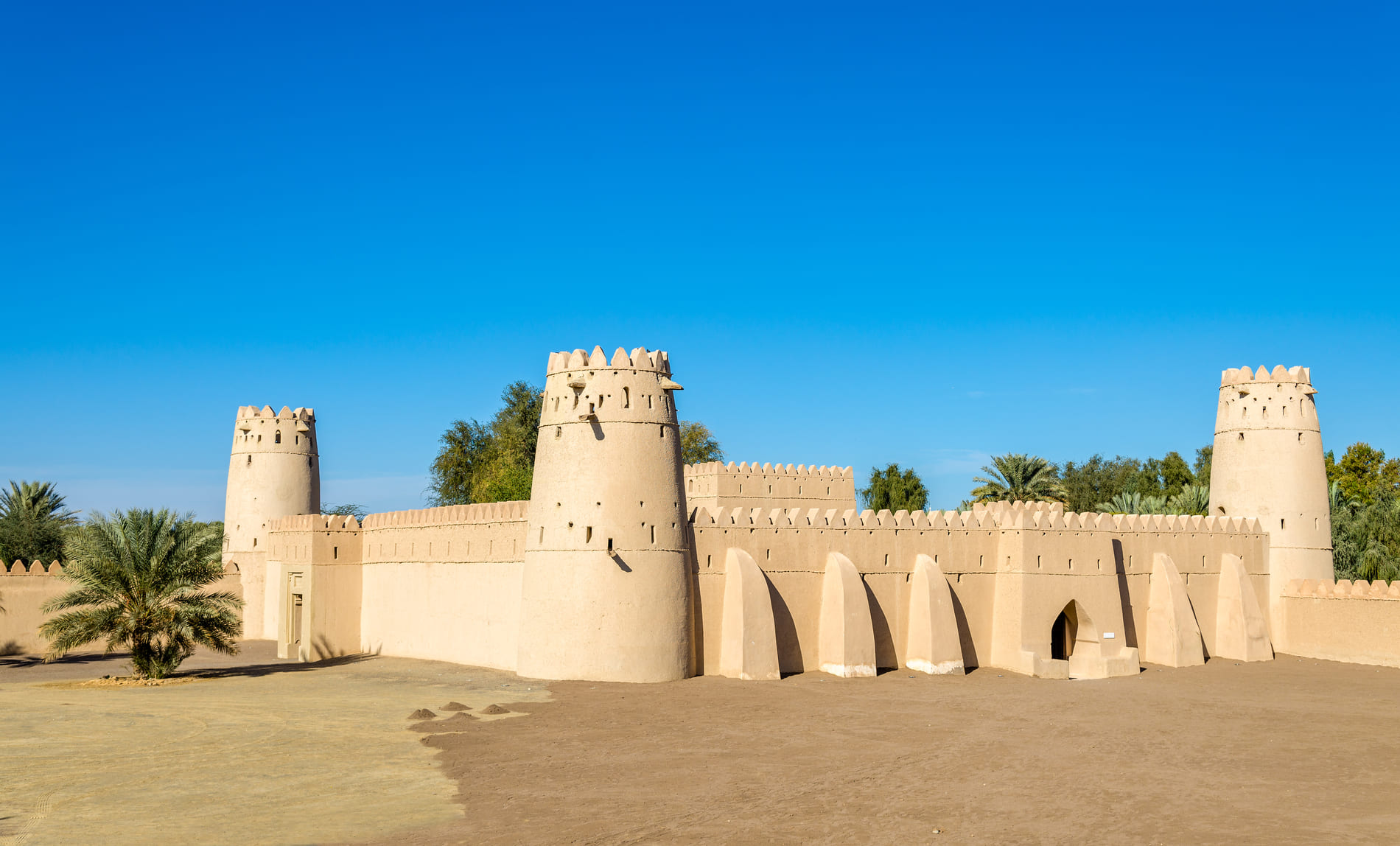
The Al Jahili building consists of a wide variety of traditional mud buildings housed in other parts of Al Ain, including around the castle, a square tower with defensive towers at its corners, two large fenced doors, and a mosque outside the walls. Recent work has revealed the remains of a falaj or covered irrigation channel.
The various elements of the structure provide a strong physical and visual link to important local and regional historical events of both the nineteenth and twentieth centuries. Today, its unique downtown location and unique landscape help Al Alahili Fort to showcase the traditional architecture and cultural heritage of Abu Dhabi.
The oldest parts are the inner fortress and the various circular towers. The inscription on the south gate shows that the inner fortress dates back to the 1890s when it was built by Sheikh Zayed the First. The previous building of buildings had been destroyed in 1955 when Sheikh Shakhbut donated the hero the Truck Oman Levies (TOL). This military operation continued until the fort was transferred to the defense force in 1971. From 1986-89 the restoration of the fort included the construction of one large courtyard now used for ancient music concerts and other public events. The main entrance now adjacent to the main towers was added during the 1986-89 restoration. All the new parts of the building added in the 1980s were built using the same traditional combination of mud walls with palm-tree roofs.
The preservation and rehabilitation activities undertaken by the Department of Culture and Tourism in 2007 retained the fabric and significance of this historic building, while the latter parts of the building were transformed into a functional tourist center with a permanent and temporary exhibition center. The conservation and development process is being widely publicized through archeological research and documentation that allows for the preservation and interpretation of various parts of the building.
The idea of the project was to combine traditional materials with clay building techniques and new modern technologies to allow for further cooling inside the rooms around the high-end gallery. The technology used in the building adds to the thermal properties of the existing earth walls to provide a comfortable environment for modern use throughout the year. This is achieved by the use of a series of cold water pipes placed under the mud concrete in almost every vertical and horizontal position, cooling the structure where the summer temperature in Al Ain can reach 50 ° C.
The project also sought to increase the profile and emphasized the importance of pottery structures in the UAE’s architectural heritage, while emphasizing the green and recyclable properties of traditional materials in Al Ain buildings, especially land and a wide variety – palm products. The project was awarded the prestigious Terra Award award at terra Lyon 2016, 12th World Congress on Earthen Architectures. The next conservation work in 2013 involved the construction of a nineteenth-century north gate of confinement based on archaeological evidence and historical photographs.
The northern wing of the courtyard is dedicated to the eternal black-and-white art exhibition by pilgrim Wilfred Thesiger and is entitled ‘Bin London and Freedom of the Desert’. The western wing is used as a temporary exhibition center, with a court opening, and the southern wing contains an information center for visitors to the castle and Al Ain, as well as a bookstore and majlis.
The integration of traditional materials and new technologies has produced a structure that is in harmony with nature and history in harmony with its environment. Al Jahili Fort, with its exhibition grounds and information center, is the first of its kind to integrate these traditional and new technologies within the context of a large mud building and has become an example of the re-use of traditional buildings to date the needs of the UAE and the region.
OPENING HOURS:
It is open every day except Mondays, From 9:00 a.m. to 5:00 p.m. Friday: 3:00 pm to 5 p.m.
LOCATION:
The fort is located in the southern part of the city of Al Ain near the Al Ain Castle Museum. It is located in an ideal location with water resources and agricultural land.
ART GALLERY:
Similar to the Mezyad Fort, Jahili Fort is one of the largest castles in the city. It is part of a larger complex of public service that includes a public square. The fort is square and has a length of 35 meters (115 meters) and a height of 8 meters (26 feet). There are triangular embryos and balloons at the top. It has three circular guard towers and a rectangular tower at the northwest corner. The surrounding barns are 5 meters (16 m) wide, and 14 meters high (46 feet). Rectangular watches have a width and length of 4 and 7 meters (13 and 23 meters) respectively, and a height of 14 meters (46 feet). A rectangular tower is considered to be the strongest defense.
RESTORATION:
The fort was restored by the Department of Archeology and Museum in Al Ain in the mid-1980s. It was also restored by the Abu Dhabi Authority for Culture & Heritage in 2007-2008, in which a number of infrastructures were installed, including a visitor’s office, gift shops, a cafe, and a comprehensive community exhibition and cultural center. The fort is scheduled to be renovated in the future with major tourist and social roles in the Al Ain region.