






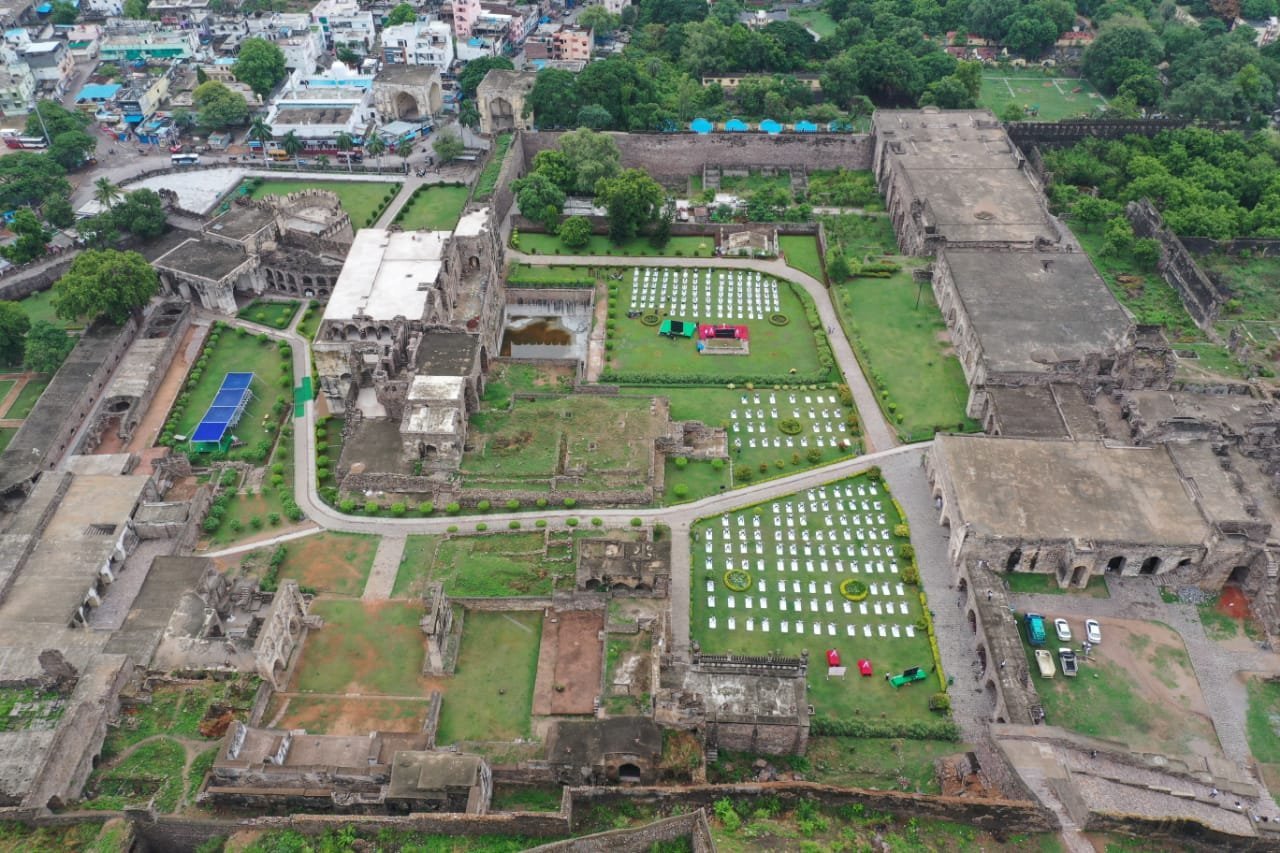


Red Fort Delhi
The Red Fort, also known as Lal Qila, is a historical fortification located in Old Delhi, India. It was constructed by the Mughal emperor Shah Jahan in the mid-17th century, and served as the palace and royal residence for the Mughal emperors until the late 19th century. The fort is now a UNESCO World Heritage Site and a popular tourist attraction in Delhi.
The Red Fort is built with red sandstone and stretches over an area of 254.67 acres. The fort features walls that are up to 33 meters high and 2.5 kilometers long, enclosing various structures such as palaces, gardens, halls, and mosques. The fort is a fine example of Mughal architecture and design, combining Indian, Persian, and European elements.
The fort has two main gates, the Lahori Gate and the Delhi Gate, and visitors enter through the former. As you enter, you’ll find yourself in Chatta Chowk, a covered bazaar where various items such as jewelry, textiles, and souvenirs are sold. The bazaar was once reserved only for the royal family and their guests.
After passing through the Chatta Chowk, you’ll enter the Naubat Khana or the Drum House, where musicians used to play for the emperor. You’ll then come across the Diwan-i-Aam, or the Hall of Public Audience, where the emperor would meet his subjects and hear their grievances. The hall is decorated with intricate carvings and beautiful Persian calligraphy.
The next attraction is the Diwan-i-Khas, or the Hall of Private Audience, where the emperor would receive his guests and have private meetings. The hall is decorated with semi-precious stones and intricate carvings, and it is said that the famous Peacock Throne, adorned with rubies and emeralds, was once kept here.
Another interesting attraction within the fort is the Khas Mahal, or the Private Palace, where the emperor and his family resided. The palace has a central marble pool that was used for bathing, and the walls are decorated with paintings and carvings.
The fort also houses the Hayat Baksh Bagh, or the Life-Giving Garden, which is a beautiful garden filled with fountains and water channels. The garden was used for royal recreation and relaxation.
One of the most impressive structures within the fort is the Moti Masjid, or the Pearl Mosque, which is a white marble mosque built by Emperor Aurangzeb in the 17th century. The mosque features three domes and two minarets, and it is said that the mosque glows like a pearl in the sunlight.
The Red Fort is also famous for its light and sound show, which is held in the evenings. The show recounts the history of the fort and the Mughal empire, and it is a great way to learn more about the fort’s past.
In addition to its historical and cultural significance, the Red Fort is also an important political landmark in India. Every year on August 15th, which is India’s Independence Day, the Prime Minister of India hoists the national flag from the ramparts of the fort.
Maps
Opening Hours
Video
FAQ's
What is an ancient monument?
In the AMASR Act, ancient monument means any structure, erection or monument, or any tumulus or place of interment, or any cave, rock sculpture, inscription or monolith, which is of historical, archaeological or artistic interest provided it has been in existence for not less than one hundred years.Definition of monument in the Act, also includes the remains or the site of an ancient monument. Not only that the portion of land adjoining the site of an ancient monument which may be required for fencing or covering in or otherwise preserving such monument, and the means of access to the monument are also termed as ancient monument.
How a monument is declared protected?
Where the Central Government is of opinion that any ancient monument is of national importance it issues a notification (preliminary) in the Official Gazette, of its intention to declare such ancient monument to be of national importance. A copy of every such notification shall be affixed in a conspicuous place near the monument.The notification gives two months’ notice. After the issue of the notification, any person, who may be, interested in any such ancient monument may, object to the declaration within two months. After considering the objections, received during this period, the Central Government may declare the ancient monument to be of national importance by publishing the notification (final) in the Official Gazette.A notification published under section 4 (3) makes the ancient monument to be of national importance for the purposes of this Act.
What is antiquity?
In the AMASR Act, antiquity means any coin, sculpture, manuscript, epigraph, or other work of art or craftsmanship. It also include any article, object or thing detached from a building or cave, and any article, object or thing illustrative of science, art, crafts, literature, religion, customs, morals or politics in bygone ages, any article, object or thing of historical interest.Besides the Central Government may also declare any article, object or thing as antiquity by notification in the official gazette for the purpose of this act.Provided any such object has been in existence for not less than 100 years.
What does archaeological site and remains means?
In the AMASR Act, archaeological site and remains means any area which contains or is, reasonably believed to contain ruins or relics of historical or archaeological importance, which have been in existence for not less than one hundred years.The portion of land adjoining the area which may be required for fencing or covering in or otherwise preserving the site and remains and the means of access to, are also included in archaeological site and remains.
What does a protected area means?
Any archaeological site and remains which is declared to be of national importance by or under this Act is called protected area.All archaeological sites and remains which have been declared by the Ancient and Historical Monuments and Archaeological Sites and Remains (Declaration of National Importance) Act, 1951, or by section 126 of the States Reorganisation Act, 1956 to be of national importance shall also be deemed to be protected areas for the purposes of this Act.
What is the difference between a protected area and a protected monument?
When any archaeological site and remains is declared to be of national importance it is called protected area whereas an ancient monument when declared to be of national importance is called protected monument.
How an archaeological site and remains is declared protected?
Where the Central Government is of opinion that any archaeological site and remains is of national importance it issues a notification (preliminary) in the Official Gazette, of its intention to declare such archaeological site and remains to be of national importance. A copy of every such notification shall be affixed in a conspicuous place near the archaeological site and remains.The notification gives two months’ notice. After the issue of the notification, any person, who may be, interested in any such archaeological site and remains may, object to the declaration within two months.After considering the objections, received during this period, the Central Government may declare the archaeological site and remains to be of national importance by publishing the notification (final) in the Official Gazette.A notification published under section 4 (3) makes the archaeological site and remains to be of national importance for the purposes of this Act.
What if any construction is made in a protected area without the permission of the Central Government?
The Central Government may, by order, direct that any building constructed by any person withina protected area in contravention of the provisions of this act shall be removed within a specified period and, if the person refuses or fails to comply with the order, the Collector may cause the building to be removed and the person shall be liable to pay the cost of such removal.
What if the owner or occupier of a protected area misuse or utilise such area or any part thereof in any other manner without the permission of the Central Government?
No person, including the owner or occupier of a protected area, shall utilise protected area or any part thereof in any other manner without the permission of the Central Government whoever contravene it shall be punishable with imprisonment which may extend to three months, or with fine which may extend to five thousand rupees, or with both.
What is excavation?
The AMASR Act does not give any definition of the excavation. However the Recommendation on International Principles Applicable to Archaeological Excavations made by the General Conference of the UNESCO, at its ninth session at New Delhi in 1956, defines the excavation in detail. According to the Article 1 of UNESCO recommendation “by archaeological excavations is meant any research aimed at the discovery of objects of archaeological character, whether such research involves digging of the ground or systematic exploration of its surface or is carried out on the bed or in the sub-soil of inland or territorial waters…”
Who regulates excavations in the country?
Archaeological site and remains being in the list I and III of the Constitution of India, the Central Government, through the Archaeological Survey of India, regulates all the archaeological excavations in the country.According to the AMASR Act prior approval of the Central Government is a must for undertaking any excavation for archaeological purposes, in any area whether it is protected or other than protected area.
Can excavation be carried out in a protected area?
An archaeological officer or a licencee can undertake excavation for archaeological purposes in any protected area.Excavation, by a licencee, must be conducted under and in accordance with the terms and conditions of a licence, issued by the Director General of the ASI.
Who grants licence for excavation in protected areas?
The Director General, Archaeological Survey of India grants the licence for the excavation in protected area.
How to apply for getting for conducting excavation in protected area?
Every application for licence shall be in Form II. The application should be made to the Director General at least three months before the proposed date of the commencement of the excavation operations.
Is there any rule for submission of report of the results of the excavation?
Within three months of the completion of the excavation operations, the licensee shall, submit to the Director-General a summary report of the results of the excavation. Where the operations are carried on for a period of more than three months such report shall be submitted every quarter. It shall be open to the Director-General to publish the report in his reports or reviews.
How long an excavation may be conducted?
Every licence shall be in force for such period not exceeding three years as may be specified in the licence. The Director-General may extend its period by one year at a time on application made to him at least one month before the expiry of a licence.The aggregate period of any licence does not exceed five years. In other words no excavation in any protected area can be conducted for more than five years.
What is the opening time of protected monuments?
The protected monuments specified in the First Schedule shall remain open during the hours specified against them in that Schedule.Protected monuments for which any agreement is made between owner and the Central Government under section 6 or if any order is made under section 9, will open as per the condition in the agreement of the order. All other monuments shall remain open from sunrise to sunset for public.
Are there different categories among the monuments of national importance?
All the monuments declared to be of national importance are of equal importance. However, for the purpose of entree fee protected monuments have been classified in two categories. Those which are declared as World Heritage properties by UNESCO are kept in category A where as other monuments where entree fee is charged are classified as category B monuments.
What is the present fee structure?
Persons above the age of fifteen years need to pay an entrance fee for the entree in protected monuments.
What is copying?
Copying, together with its grammatical variations and cognate expressions, means the preparation of copies by drawing or by photography or by mould or by squeezing and includes the preparation of a cinematographic film and video film with the aid of a hand camera which is capable of taking films of not more than eight millimeters and which does not require the use of a stand or involve any special previous arrangement.
Can one take photographs of protected monuments?
One can take photograph of any protected monument. One is not authorize to bring camera stand, extra lights, or any such appliance
Who can grant permission for photography in monuments?
One can use camera stand, artificial lights or any such appliance with the permission granted by an archaeological officer in writing.
What is the opening time of protected monuments?
The protected monuments specified in the First Schedule shall remain open during the hours specified against them in that Schedule.Protected monuments for which any agreement is made between owner and the Central Government under section 6 or if any order is made under section 9, will open as per the condition in the agreement of the order. All other monuments shall remain open from sunrise to sunset for public.
Are there different categories among the monuments of national importance?
All the monuments declared to be of national importance are of equal importance. However, for the purpose of entree fee protected monuments have been classified in two categories. Those which are declared as World Heritage properties by UNESCO are kept in category A where as other monuments where entree fee is charged are classified as category B monuments.
What is the present fee structure?
Persons above the age of fifteen years need to pay an entrance fee for the entree in protected monuments.
What does Prohibited area mean?
Prohibited area means an area near or adjoining a protected monument which the Central Government has, by notification in the Official Gazette, declared to be a prohibited area for purposes of mining operation or construction or both.
How much is the prohibited area?
The Central Government has declared areas up to 100 meters from the protected limits of all the protected monuments as to be prohibited area for purposes of both mining operation and construction.
Can one construct on the land in a prohibited area?
No construction can be made in a prohibited area.
What if some one constructs unauthorized building in prohibited area?
The Central Government may, by order, direct the owner or occupier of an unauthorised building in a prohibited area to remove such building within a period specified in that order.If the owner or occupier refuses or fails to comply with such order the Central Government may direct the District Magistrate to remove it and the owner or occupier shall be liable to pay the cost of such removal.